What Is Hanfu?
Hanfu (漢服, , literally "clothing of the Han") is the traditional clothing system of the Han Chinese people, worn continuously for over three thousand years from the Shang Dynasty (c. 1600 BCE) through the Ming Dynasty (1368–1644 CE). It is not a single garment but a comprehensive clothing tradition encompassing everyday wear, court dress, ceremonial robes, and military attire.
The defining characteristics of Hanfu are:
- Cross-collar (交領, ) — The collar crosses over the chest in a Y-shape
- Right-side wrapping (右衽, ) — The left panel wraps over the right. This was a civilisational marker: the Lunyu (論語, ) records Confucius praising Guan Zhong for maintaining 右衽 against foreign influence. Left-wrapping (左衽, ) was associated with non-Han peoples.
- Wide sleeves (廣袖, ) — Flowing sleeves that varied in width across dynasties and occasions
- Sash tie (繫帶, ) — Garments secured by sashes and ties rather than buttons, reflecting an aesthetic of flowing, unbroken lines
Shang and Zhou Dynasties — The Foundations
The earliest Chinese clothing system followed the 上衣下裳 () principle: an upper garment (衣, ) paired with a lower skirt (裳, ). Archaeological evidence from Shang Dynasty tombs reveals sophisticated silk weaving technology, with fragments showing complex patterns including geometric designs, dragons, and phoenixes.
Silk — China's Unique Contribution
China independently developed silk production (絲綢, ) from the cultivation of silkworms (Bombyx mori) — the world's only fully domesticated insect. The earliest silk fragments date to approximately 3630 BCE (Hemudu culture, Zhejiang). By the Shang Dynasty, silk weaving was highly advanced, producing damask, gauze, and embroidered fabrics of remarkable quality.
Silk was not merely a textile but a form of currency, a medium of diplomacy, and a marker of social rank. The character 幣 (bì, currency/gift) originally depicted bolts of silk, reflecting the material's monetary function in ancient China.
Zhou Dynasty Formalisation
The Zhou Dynasty (1046–256 BCE) established the ritual clothing system (冕服, ) that linked garment type, colour, and ornamentation to social rank and ceremonial function. The Zhouli (周禮, , Rites of Zhou) codified clothing regulations in extraordinary detail:
- Twelve-symbol imperial robe — The emperor's ceremonial robe bore twelve cosmological symbols: sun, moon, stars, mountains, dragons, pheasants, sacrificial vessels, aquatic grass, grain, fire, axe heads, and the fu symbol
- Five ceremonial colours — Corresponding to the five elements: blue-green (Wood), red (Fire), yellow (Earth), white (Metal), black (Water)
- Rank differentiation — Nobles wore silk; commoners wore hemp and ramie. Specific colours and patterns were restricted by sumptuary law.
Han Dynasty — The Golden Age
The Han Dynasty (206 BCE – 220 CE) gave Hanfu its name and established the clothing tradition that would define Chinese identity for the next two millennia. The dynasty's four-century duration allowed clothing styles to mature and stabilise, creating forms that later dynasties referenced as the classical standard.
Key Han Dynasty Garments
- Shenyi (深衣, ) — The "deep garment," a full-body robe combining upper and lower sections into a single flowing piece. It wrapped around the body and was secured with a sash, embodying the Confucian ideal of modesty and dignity.
- Quju (曲裾, ) — A curved-hem robe that wrapped diagonally around the body, creating elegant layered lines. Especially popular for women during the Western Han.
- Zhiju (直裾, ) — A straight-hem robe that became dominant by the Eastern Han, simpler to construct and wear than the quju
Han Dynasty tomb paintings and terracotta figures provide extensive visual evidence of clothing styles. The famous Mawangdui silk garments (Changsha, Hunan, c. 168 BCE) — including a gauze robe weighing only 49 grams — demonstrate the extraordinary refinement of Han textile technology.
The Silk Road Opens
Emperor Wu's dispatching of Zhang Qian (張騫, ) to the Western Regions in 138 BCE opened the trade routes that would become the Silk Road. Chinese silk — the most prized luxury commodity in the ancient world — began flowing westward to Persia, Rome, and beyond, while foreign textiles, dyes, and design influences began entering China.
Niya: Hanfu at the Edge of the Desert
Some of the best-preserved Han-era garments ever found come not from central China but from the Niya archaeological site (尼雅遺址, ) — the ruins of the ancient kingdom of Jingjue (精絕國, ), one of the thirty-six kingdoms of the Western Regions recorded in the Hanshu (漢書, , Book of Han). Niya lies in what is now Minfeng County, Xinjiang, at the southern edge of the Taklamakan Desert.
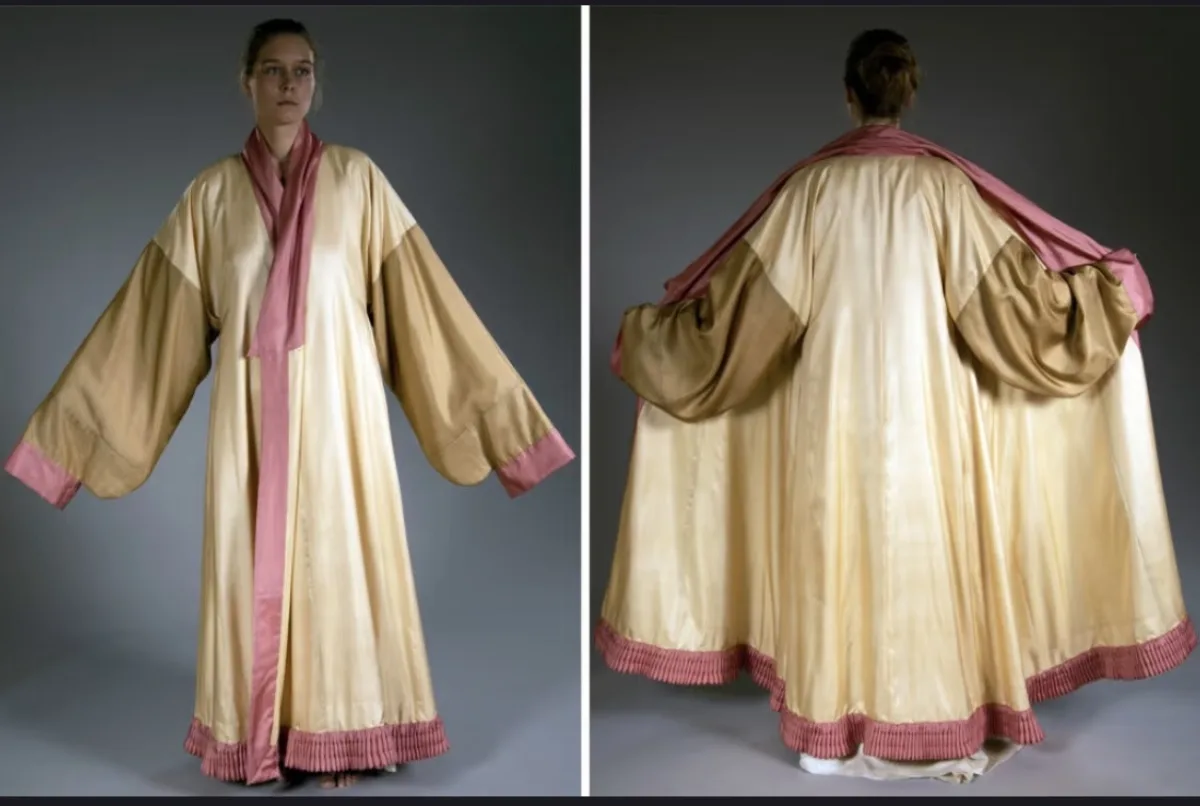
In 1995, a Sino-Japanese archaeological expedition excavated tomb 95MNIM5, uncovering a complete set of clothing on a female mummy dated to approximately 60–130 CE (Eastern Han to early Jin). The preservation — made possible by the extreme desert aridity — is extraordinary: silk retains its sheen, colours remain vivid, and construction details are fully legible.
The Garments
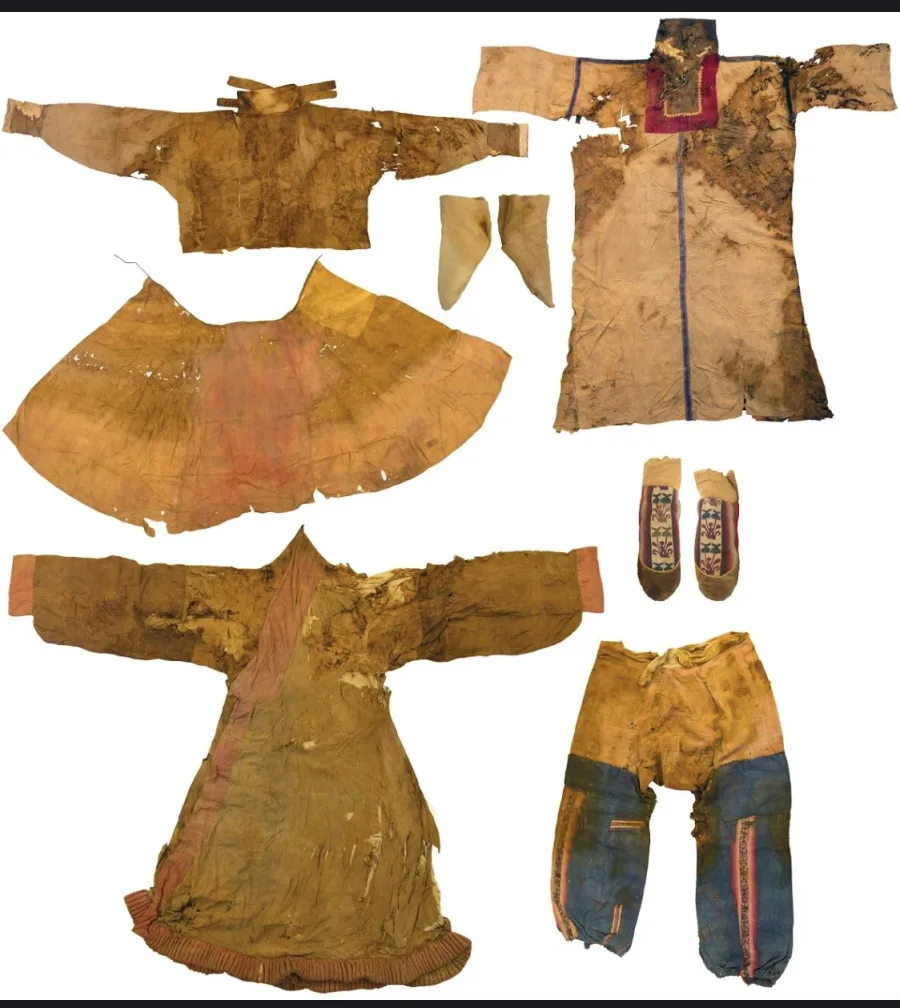
The M5 tomb yielded a remarkably complete wardrobe:
- Silk robe (絲綢長袍, ) — A full-length cross-collar robe in cream-gold silk with pink silk trim and a pleated hem band. The cut follows the classic Han shenyi (深衣, ) form: wide sleeves, flowing skirt, sash-tied closure.
- Silk skirt (絲裙, ) — A separate skirt piece, consistent with the ancient 上衣下裳 (, upper garment, lower skirt) tradition.
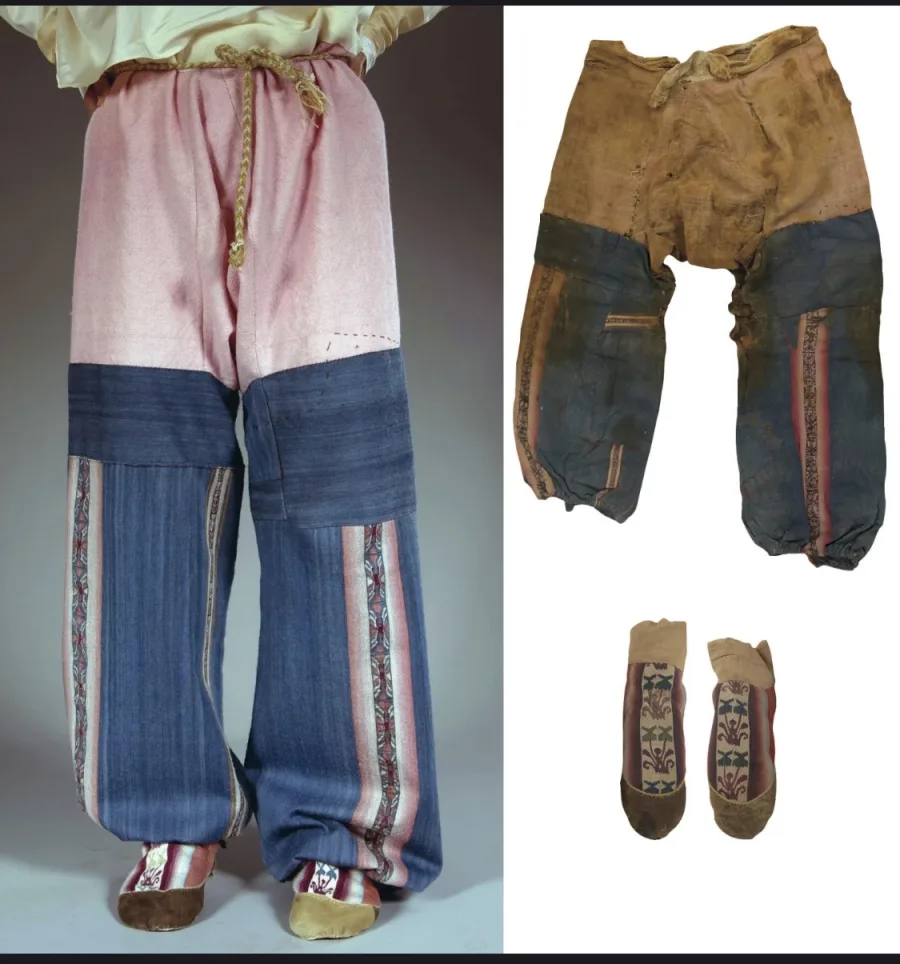
- Woollen trousers (毛織褲, ) — Two-tone trousers with a pink upper section and indigo lower section, featuring decorative woven bands with floral and geometric motifs along the side seams — a blend of Central Asian tailoring with Chinese textile artistry.
- Embroidered socks (錦襪, ) — Ankle-high socks with elaborate woven panels depicting stylised palmettes and floral scrolls, showing Hellenistic design influence transmitted along the Silk Road.
The "Five Stars" Brocade
The Niya site is also the provenance of China's most celebrated ancient textile: the "Five Stars Rise in the East to Benefit China" (五星出東方利中國, ) brocade armguard, discovered in tomb M8 in 1995. This polychrome silk brocade — woven with the auspicious phrase in Han-script characters alongside animal motifs — is now a First-Class National Treasure (國家一級文物, ) and the emblem of China's Silk Road archaeology. It was designated as one of the cultural heritage items forbidden from leaving the country for exhibition.
Hanfu 4,000 km from Chang'an
The Niya garments demonstrate that Han Chinese clothing style was worn at the furthest reaches of the Western Regions — nearly 4,000 km from the Han capital of Chang'an. The silk robe's cross-collar, right-over-left construction is unmistakably youren (右衽, ) — the civilisational marker that Confucius praised. The garments were reconstructed by archaeologist Mayke Wagner and her team at the German Archaeological Institute (DAI) as part of the "Silk Road Fashion" research project (published in Archaeological Research in Asia, Vol. 43, 2025).
Tang Dynasty — Cosmopolitan Splendour
The Tang Dynasty (618–907 CE) produced the most cosmopolitan and innovative period in Chinese fashion history. As the world's wealthiest and most internationally connected civilisation, Tang China absorbed influences from Central Asia, Persia, India, and the Silk Road cultures while maintaining the fundamental Hanfu structure.
Women's Fashion
Tang Dynasty women's clothing was notably bold and varied:
- Ruqun (襦裙, ) — A short upper garment paired with a high-waisted, floor-length skirt, often in vivid colours. The high waistline (sometimes reaching under the armpits) created a distinctive silhouette.
- Low necklines — Tang court fashion included necklines that exposed the upper chest — a dramatic departure from the covered styles of earlier and later dynasties, reflecting Tang cultural confidence and openness.
- Hufu (胡服, ) — Fashionable women adopted "barbarian clothing" — fitted jackets, narrow trousers, and riding boots from Central Asian styles, sometimes paired with traditional skirts in eclectic combinations.
- Banbi (半臂, ) — A short-sleeved outer garment worn over the ruqun, adding a layered aesthetic
The murals of Dunhuang and the painted pottery figurines (唐三彩, , Tang Sancai) preserve vivid records of this fashion exuberance — plump-figured women in flowing colours, riding horses, playing polo, and participating in court life with a freedom unmatched in later dynasties.
Men's Fashion and Court Dress
Tang men's official dress centred on the yuanlingpao (圓領袍, ) — a round-collared robe that became the standard for officials. Colour indicated rank: purple for the highest officials, then crimson, green, and blue in descending order. This Tang system influenced court dress across East Asia, including Japan, Korea, and Vietnam.
Song Dynasty — Elegant Restraint
The Song Dynasty (960–1279 CE) marked a shift toward refined elegance and understated sophistication. Where Tang fashion was exuberant and cosmopolitan, Song style favoured subtlety, natural colour palettes, and meticulous craftsmanship over spectacle.
Aesthetic Principles
Song clothing reflected the dynasty's Neo-Confucian intellectual culture, which valued moral cultivation and inner virtue over outward display. Dominant colours were soft: pale greens, muted blues, cream, and dove grey. Silk weaving reached new heights of technical refinement, producing fabrics with subtle patterns woven into the material itself (rather than applied through embroidery).
- Beizi (褙子, ) — An open-fronted, long outer garment worn by both men and women. It became the signature Song Dynasty garment — practical, elegant, and versatile.
- Narrow sleeves — Contrasting with the wide sleeves of Han and Tang, Song fashion favoured narrower, more practical sleeve widths
- Moxiong (抹胸, ) — A wrapped chest garment worn by women as an inner layer
The Silk Industry
The Song Dynasty's advanced commercial economy transformed silk from a luxury and tribute item into a mass-produced commodity. Hangzhou, Suzhou, and the Jiangnan region became the centres of silk production — a status they retain today. The invention of the drawloom allowed complex patterns to be woven mechanically, and Song silk was exported across the maritime Silk Road to Southeast Asia, India, and the Middle East.
Ming Dynasty — Restoration and Splendour
The Ming Dynasty (1368–1644 CE) represented a conscious restoration of Han Chinese culture after the Mongol Yuan Dynasty. The founding emperor Zhu Yuanzhang (朱元璋, ) explicitly decreed the abolition of Mongol clothing and the revival of Tang and Song Hanfu forms.
The Mandate of Cultural Restoration
In 1368, immediately upon establishing the Ming Dynasty, Zhu Yuanzhang issued an edict: "Restore the garments of Tang" (復唐制衣冠, ). Mongol-style clothing — including the distinctive zhisunfu (質孫服, ) — was banned, and a comprehensive new clothing code based on Han precedents was promulgated.
— Ming Shi (明史, ), "Treatise on Carriages and Clothing"Key Ming Dynasty Developments
- Mandarin Square (補子, ) — Square embroidered badges on official robes indicating rank: civil officials bore bird motifs (crane for 1st rank, golden pheasant for 2nd, etc.); military officials bore animal motifs (qilin for 1st rank, lion for 2nd, etc.). This system was later adopted by the Qing and influenced Korean and Vietnamese court dress.
- Aoqun (襖裙, ) — The dominant women's garment: a jacket (ao) paired with a pleated skirt (qun). Ming women's clothing featured elaborate embroidery, gold thread work, and the distinctive "horse-face skirt" (馬面裙, ) with its flat front and back panels and pleated sides.
- Colour hierarchy — Yellow reserved exclusively for the emperor. Red for high officials and festive occasions. Blue and green for lower ranks. White for mourning. Black for commoners.
The Ming represented the final and most elaborate expression of the Hanfu tradition. Its clothing system combined the ceremonial grandeur of the Zhou, the flowing elegance of the Han, the cosmopolitan richness of the Tang, and the refined craftsmanship of the Song into a comprehensive synthesis.
The Silk Road (絲綢之路, )
The Silk Road — the network of trade routes connecting China to Central Asia, Persia, the Middle East, and ultimately Rome — was named for its most valuable commodity: Chinese silk. The textile that clothed China's elite became the foundation of the ancient world's most important commercial and cultural exchange network.
Overland Routes
The overland Silk Road, formally opened by Zhang Qian's missions (138–126 BCE) during the Han Dynasty, carried Chinese silk westward through the Gansu Corridor, across the Taklamakan Desert (via oasis cities like Dunhuang, Turfan, and Kashgar), through Central Asia to Persia and the Mediterranean. Silk was so prized in Rome that the Senate repeatedly attempted to ban its import, fearing the drain of gold reserves.
Maritime Routes
By the Song Dynasty, maritime trade routes through the South China Sea to Southeast Asia, India, Arabia, and East Africa became increasingly important. The port cities of Quanzhou (泉州, ), Guangzhou (廣州, ), and Hangzhou became cosmopolitan trading hubs. Chinese silk, porcelain, and tea flowed outward; spices, gems, incense, and foreign textiles flowed in.
Two-Way Cultural Exchange
The Silk Road was never a one-way street. Foreign textiles and techniques entered China and influenced fashion:
- Persian weaving patterns — Roundel motifs and symmetrical animal designs appeared in Tang Dynasty silks, reflecting Sassanid Persian artistic influence
- Central Asian dyes — New dyeing techniques and colour palettes reached China along the trade routes
- Cotton — Originally from India, cotton cultivation spread to China via the Silk Road, eventually becoming a major textile alongside silk
- Gold thread (金線, ) — Techniques for weaving gold thread into fabric were refined through contact with Central Asian and Byzantine traditions
In 1645, the newly established Qing Dynasty — founded by the Manchu people from the northeast — issued the most consequential clothing edict in Chinese history: the Tifayifu (剃髮易服, , "shave the head and change clothing") order.
The Edict
All Han Chinese men were ordered to:
- Shave the front of their heads and grow the remaining hair into a queue (辮子, ) — the Manchu hairstyle
- Abandon Hanfu and adopt Manchu-style clothing: stand-up collars, "horsehoof" cuffs (馬蹄袖, ), frog-button closures, and tight-fitting cuts designed for horsemanship
The penalty for non-compliance was death. The edict was summarised in the chilling phrase: "留髮不留頭,留頭不留髮" () — "Keep the hair, lose the head; keep the head, lose the hair."
Resistance and Consequences
Resistance to the edict was fierce and widespread. The Jiangyin massacre (1645) saw the city's population resist the queue order for 81 days before the Qing army breached the walls, killing an estimated 80,000–100,000 people. Similar resistance occurred in Jiading, Kunshan, and throughout southern China.
The edict was more strictly enforced for men. Women's clothing was less rigorously regulated, and some Han elements persisted in women's dress, particularly in southern regions. Buddhist monks were also exempted, allowing monasteries to preserve some traditional clothing knowledge.
The "Shicong Shubucong" Exceptions
Resistance was so fierce that the Qing government made strategic concessions known as "Ten Compliances, Ten Non-compliances" (十從十不從, shícóng shí bùcóng):
- Men comply, women need not (男從女不從, )
- The living comply, the dead need not (生從死不從, ) — burial in Hanfu was permitted
- Officials comply, commoners' wives need not (官從隸不從, )
- Marriage clothing complies, other occasions need not (娼從而優伶不從, )
These exceptions explain why some Han elements survived in women's dress, bridal wear, and theatrical costume — but the core Hanfu tradition for men was completely severed.
Qipao (旗袍, ) — Not Hanfu
One of the most persistent misconceptions in Chinese cultural discourse is the identification of the qipao (旗袍, also called cheongsam in Cantonese) as "traditional Chinese clothing." In historical terms, this is inaccurate. The qipao is a Manchu garment, not a Han Chinese one, and its prominence in modern China is a direct consequence of the Tifayifu edict that destroyed the Hanfu tradition.
Etymology: "Banner Person's Robe"
The name itself is revealing. 旗袍 (qípáo) literally means "Banner person's robe" — 旗 (qí) refers to the Manchu Eight Banners (八旗, Bāqí), the military-administrative system that organised the Manchu population, and 袍 (páo) means "robe." The garment descends from the changpao (長袍, ) — the long robe worn by Manchu Banner men and women in the Qing Dynasty.
The ROC and Chiang Kai-shek: Institutionalising the Qipao
In 1929, the Republic of China government officially designated the qipao and the Zhongshan suit (中山裝, , Sun Yat-sen suit) as national dress. Neither was Hanfu. This decision institutionalised the erasure of three thousand years of Han Chinese clothing heritage.
Under Chiang Kai-shek (蔣介石, ), the qipao became a deliberate symbol of the Nationalist state. This was not merely an aesthetic choice but a political one, rooted in the ROC's "Five Races Under One Union" (五族共和, wǔzú gònghé) doctrine. Chiang explicitly reframed the Han, Manchu, Mongol, Hui, and Tibetan peoples as "one nation, five clans, brothers of one family" (一個民族,五個宗族,兄弟一家, ). In a 1942 speech to Han, Manchu, Mongol, Hui, and Tibetan elders, nobility, and religious leaders in Xining, Chiang declared that all five groups were "equally positioned members of the Chinese nation" — a stance that required accommodating Manchu cultural symbols rather than restoring what the Manchu conquest had destroyed.
The designation of the qipao as national dress was thus partly a political concession to Manchu elites who had transitioned from Qing aristocracy to ROC citizenry. Restoring Hanfu would have been an implicit repudiation of the Qing Dynasty and its Manchu ruling class — politically untenable when the ROC needed the cooperation of former Qing nobility, Manchu bannermen, and the broader framework of multi-ethnic unity to govern the vast territory inherited from the Qing. The qipao served as a compromise: a garment of Manchu origin that could be rebranded as generically "Chinese," satisfying the Manchu constituency while avoiding the politically charged act of acknowledging that three thousand years of Han clothing had been destroyed by Manchu conquest.
His wife Soong Mei-ling (宋美齡, ) wore tailored qipao in diplomatic settings, projecting the garment as the face of "Chinese culture" to the Western world. The New Life Movement (新生活運動, , 1934–1949), launched by Chiang to promote Confucian discipline and modernisation, further reinforced the qipao-and-Zhongshan-suit combination as the standard of Chinese respectability — while the actual Confucian-era clothing (Hanfu) remained forgotten.
After the KMT retreated to Taiwan in 1949, the qipao continued as official formal wear for women in ROC diplomatic functions. The cumulative effect — from the Qing destruction of Hanfu, through the ROC's designation of Manchu-derived qipao as "national dress," to its international promotion by Soong Mei-ling — was that the world came to associate a Manchu garment with Chinese identity, while the actual three-thousand-year Han Chinese clothing tradition was almost completely unknown.
1920s Shanghai: The Modern Qipao
The qipao as it is known today bears little resemblance to the Qing-era Manchu robe. In the 1920s and 1930s, Shanghai tailors radically transformed the garment under Western influence: the loose, straight-cut Manchu robe was refashioned into a form-fitting, dart-seamed dress with high slits. This was a product of the Republic of China era's modernisation and Westernisation, not a continuation of any Chinese clothing tradition.
The Modern Hanfu Revival (漢服運動)
After 358 years of absence from daily life, Hanfu re-entered the Chinese public sphere in the early 2000s. On 22 November 2003, a man named Wang Letian (王樂天, ) walked through the streets of Zhengzhou wearing a hand-sewn Hanfu garment — widely considered the first public Hanfu wearing in modern China. The moment was photographed and spread online, catalysing what became the Hanfu Revival Movement (漢服運動, Hànfú Yùndòng).
The movement grew through online forums (particularly Baidu Tieba and Hanwang), university student groups, and cultural associations. By the 2020s, it had expanded into a significant cultural and commercial phenomenon, with Hanfu-themed tourism, photography studios, and fashion brands generating billions of yuan in annual revenue.
Organised Opposition
The revival has not been without organised resistance. In a revealing example from September 2011, moderators of the Baidu Tieba "Qipao Bar" (旗袍吧, ) publicly posted a detailed plan to discredit the Hanfu movement:
The "Discredit Hanfu Plan" — Baidu Tieba, 12 September 2011
The plan instructed participants to:
- Purchase cheap, inaccurate "costume shop" clothing (影楼装, )
- Wear it in public and claim it was Hanfu
- Behave offensively to create negative associations
- Carry signs with absurd slogans to make Hanfu wearers appear ridiculous
The stated goal: "As long as we create the concept that wearing Hanfu = showing off and faking, the Hanfu revival will never succeed." (「只要在社会中造成穿汉服=作秀、炒作的概念就好了……大家都来诋毁汉服啊!」)
— Baidu Tieba "穿越女吧" (Time Travel Women Forum), post by "旗袍吧吧务组" (Qipao Bar Moderator Group), 12 September 2011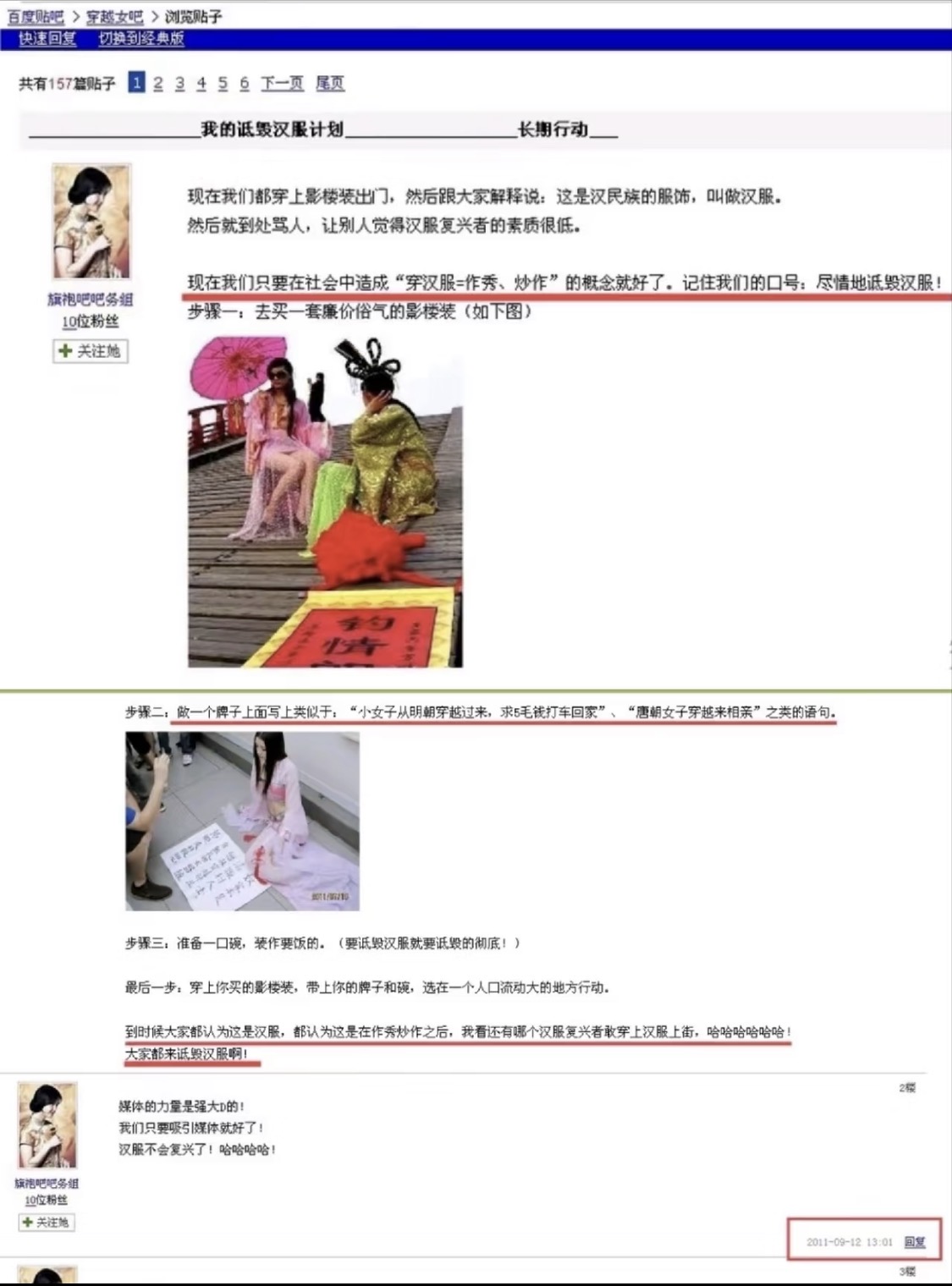
This incident — openly conducted and documented on a major Chinese internet platform — illustrates the cultural tensions surrounding the reclamation of Han Chinese identity after centuries of Qing-era suppression. It also demonstrates that opposition to the Hanfu revival was not merely passive indifference but, in some cases, actively coordinated sabotage.
Joseon Korea: "All Follow Hua-Zhi"
Korea's adoption of Chinese clothing systems is not a modern Chinese claim — it is documented in Korea's own official court records. The Joseon Wangjo Sillok (朝鮮王朝實錄, , Veritable Records of the Joseon Dynasty), a UNESCO Memory of the World document (inscribed 1997), repeatedly records Joseon officials stating that their kingdom's clothing and ritual institutions "all follow" the Chinese system.
The Primary Sources
Three entries from the Taejong Sillok (太宗實錄, ) — the records of King Taejong (r. 1400–1418) — are particularly explicit:
Taejong Sillok, Year 10 (1410)
In a memorial about paper currency, the Saganwon (司諫院, , Office of the Censor-General) stated:
吾東方禮樂文物,一遵華制
"Our Eastern [kingdom]'s ritual music and cultural institutions uniformly follow the Hua-zhi [Chinese/Hua-Xia system]."
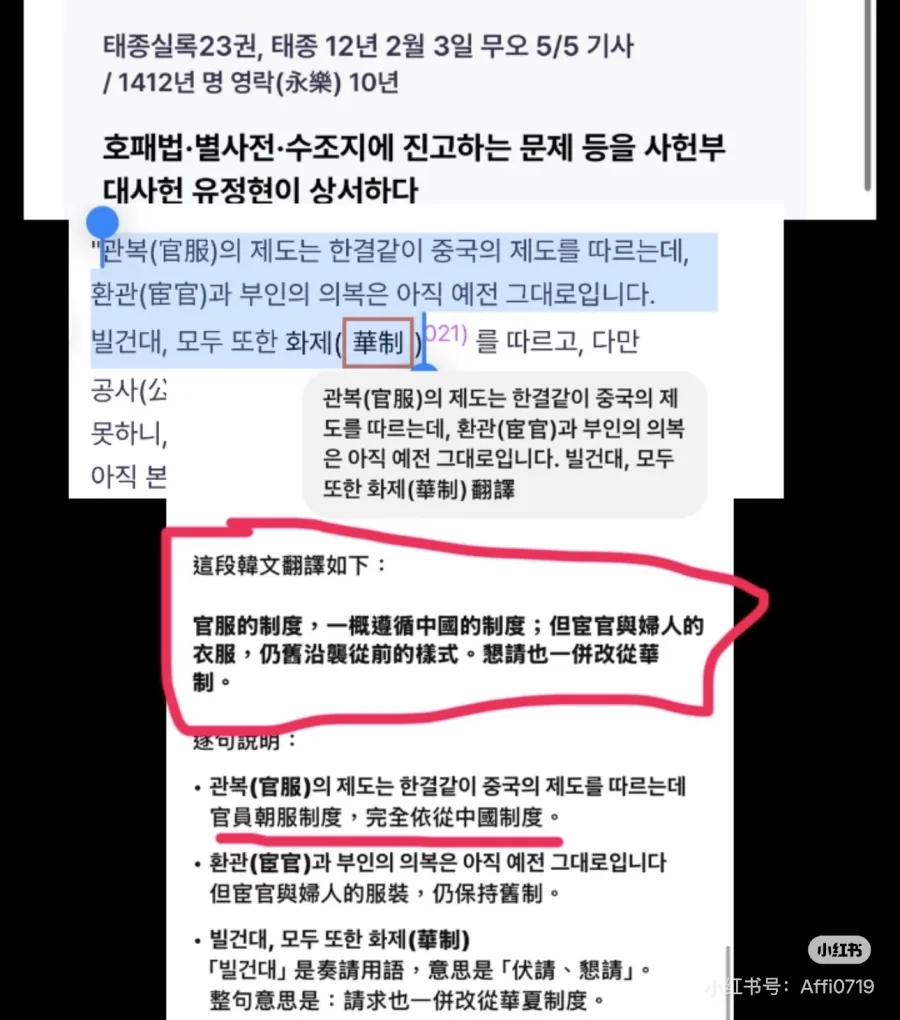
Taejong Sillok, Year 12 (1412) — 2nd Month
Chief Censor Yu Jeonghyeon (柳廷顯, ) memorialised:
官服之制,一遵中國,而宦官婦人之服,尙仍其舊,乞皆亦從華制。
"The system of official court clothing uniformly follows China, but eunuchs' and women's clothing still retains its old [customs]. We petition that [these] also all follow the Hua-zhi."
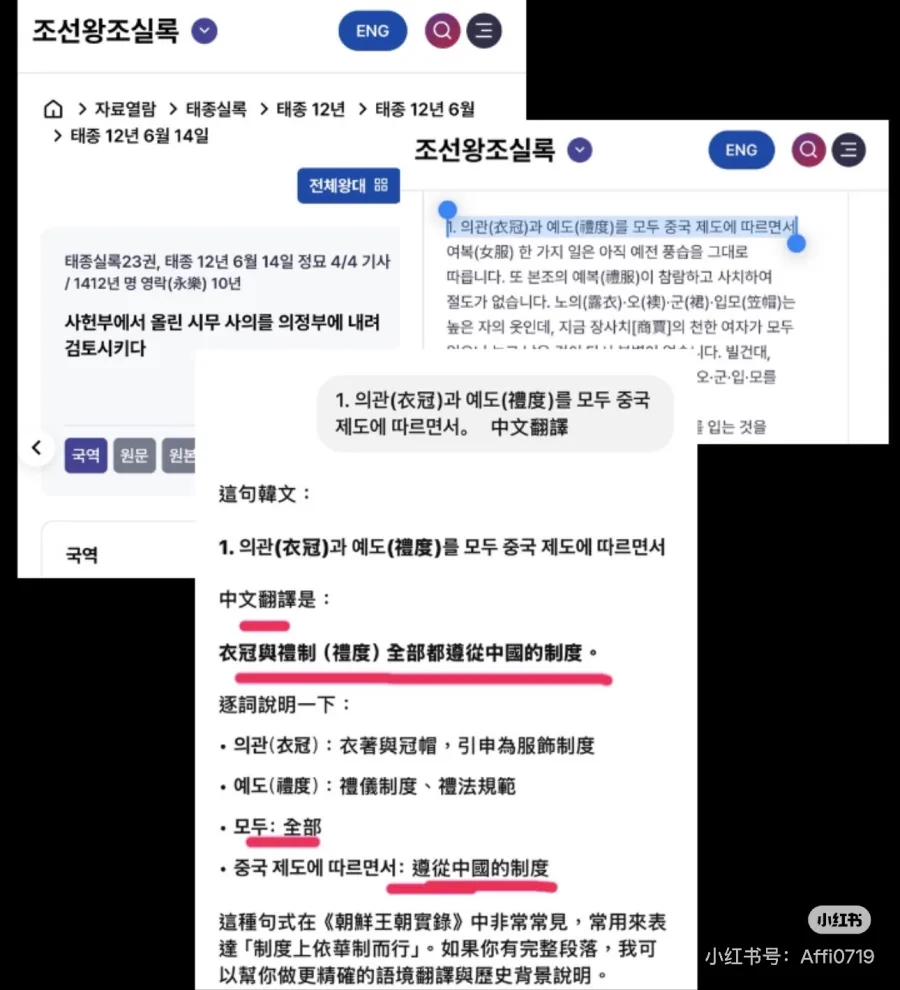
Taejong Sillok, Year 12 (1412) — 6th Month
The Saheonbu (司憲府, , Censorate) memorialised:
衣冠禮度,悉遵華制,女服一事,尙循舊習
"Clothing-and-hat [systems] and ritual institutions all follow the Hua-zhi, [but] the one matter of women's clothing still follows old customs."
What "Hua-Zhi" Means
The term 華制 () appears repeatedly throughout the Sillok. Its meaning is unambiguous: 華 () refers to 中華 (, Chinese civilisation / Hua-Xia), and 制 () means "system" or "institution." The Sillok database's own official Korean-language annotations explicitly define it as "중국의 제도" — "the Chinese system."
In practical terms, this meant the Ming Dynasty clothing regulations. Joseon court dress (gwanbok, 官服, ) was modelled directly on Ming official dress: the round-collared robe (圓領袍, ), rank badges, colour hierarchy, and ceremonial dress systems were all adopted from China. Even after the fall of the Ming in 1644, Joseon continued to maintain Ming-style clothing as a point of cultural identity, calling itself 小中華 (, "Little China").
Watch: Hanfu Through the Ages
Explore the beauty and diversity of traditional Chinese clothing across the dynasties.
Frequently Asked Questions
Hanfu (漢服, Hànfú) is the traditional clothing of the Han Chinese people, worn from the Shang Dynasty (c. 1600 BCE) through the Ming Dynasty (1368–1644). It is characterised by a cross-collar (交領), right-side wrapping (右衽), wide sleeves, and a sash tie system rather than buttons. Hanfu varied significantly across dynasties in cut, material, and ornamentation.
In 1645, the Qing Dynasty issued the Tifayifu (剃髮易服) edict, ordering all Han Chinese men to adopt Manchu hairstyles (shaved forehead with queue) and Manchu-style clothing on pain of death. This forcible replacement ended over 3,000 years of continuous Hanfu tradition. Women's clothing was less strictly regulated and retained more Han elements.
Chinese silk production — the material foundation of Hanfu — drove the creation of the Silk Road trade network. Silk was China's most valuable export from the Han Dynasty onward. The Silk Road also brought foreign textiles, dyes, and design influences into China, enriching Hanfu aesthetics, particularly during the cosmopolitan Tang Dynasty.
Shang-Zhou Hanfu was relatively simple: upper garment (衣) and lower skirt (裳). Han Dynasty Hanfu introduced flowing full-body robes (深衣). Tang Dynasty fashion was the most cosmopolitan and bold, with low necklines and foreign influences. Song Dynasty style favoured elegant restraint. Ming Dynasty Hanfu explicitly restored Han traditions with elaborate construction and rank-indicating embroidery.
Hanfu is the traditional clothing of the Han Chinese, worn for over 3,000 years until the Qing Dynasty. The qipao (旗袍) evolved from Manchu banner clothing during the Qing Dynasty — the very name means 'Banner Person's robe' (旗人之袍). The Qing Tifayifu edict (1645) forced Han Chinese to abandon their own clothing and adopt Manchu dress. The modern qipao was then reshaped in 1920s Shanghai under Western tailoring influence. They represent fundamentally different cultural traditions: Hanfu is Han Chinese; qipao is Manchu-derived and was never part of the three-thousand-year Han clothing tradition.
The Hanfu revival movement (漢服運動) began in the early 2000s when Chinese citizens started wearing traditional Han Chinese clothing in public for the first time in over 350 years. The movement has since grown into a cultural phenomenon with millions of participants. It has also faced organised opposition, including documented online campaigns to discredit Hanfu by dressing in cheap costumes and behaving offensively in public to associate traditional clothing with attention-seeking.
The Niya site (尼雅遺址) in Xinjiang — ruins of the ancient kingdom of Jingjue (精絕國) — yielded some of the best-preserved Han-era garments ever found. Tomb 95MNIM5 (c. 60–130 CE) contained a complete wardrobe: silk robes with cross-collar right-over-left construction, silk skirts, woollen trousers, and embroidered socks. The site also produced the famous 'Five Stars Rise in the East to Benefit China' (五星出東方利中國) brocade, a First-Class National Treasure.
Discussion
Sign in with GitHub to join the conversation.