When China Transmitted Its Calendar and New Year
The Chinese lunisolar calendar and its associated New Year celebration did not develop independently in neighbouring countries. In each case, the transmission mechanism is historically documented:
Vietnam — 111 BCE (Han Conquest)
The Han Dynasty conquered Nanyue (南越) in 111 BCE, placing northern Vietnam under direct Chinese administration. The Chinese lunisolar calendar was imposed as the official system for taxation, agriculture, and ritual. This was not voluntary cultural exchange — it was colonial administration. Chinese rule lasted over a thousand years (111 BCE–938 CE), during which the calendar, writing system (漢字), Confucian rituals, and New Year customs became deeply embedded. After Vietnamese independence in 938 CE, subsequent dynasties (Lý, Trần, Lê, Nguyễn) retained the Chinese calendar system.
Korea — 1st–4th Century CE (Three Kingdoms)
Korea adopted the Chinese calendar through cultural exchange during the Three Kingdoms period (57 BCE–668 CE). The kingdoms of Goguryeo, Baekje, and Silla each absorbed Chinese systems through tributary relationships, diplomatic contact, and scholarly exchange with Han and subsequent Chinese dynasties. The Joseon Dynasty (1392–1897) used the Chinese calendar as its official system. Korean zodiac terminology uses Sino-Korean readings (자/축/인/묘 etc.) — direct phonetic borrowings from Chinese.
Japan — 604 CE (via Baekje/Korea)
Japan adopted its first Chinese-style calendar — the Genka-reki (元嘉曆) — in 604 CE during the Asuka period, transmitted via the Korean kingdom of Baekje along with Buddhism, Confucianism, and the Chinese writing system. Japan subsequently imported updated Chinese calendars: the Gihō-reki (697), the Taien-reki (764), and the Senmei-reki (862). Japan used the Chinese Senmei-reki for nearly 800 years until producing its own calculated calendar (Jōkyō-reki) in 1685.
Tibet — 7th–11th Century CE
Tibet's calendar is a hybrid. The twelve-animal zodiac and five-element system were adopted from China during the Tang Dynasty period (especially after Princess Wencheng's marriage to Songtsen Gampo in 641 CE). The astronomical calculation system was later supplemented by the Indian Kālacakra system in the 11th century. The result is a calendar with Chinese structural elements (zodiac, elements, 60-year cycle) but Indian-Buddhist computational methods.
The Critical Point
No neighbouring country developed the lunisolar calendar, the twelve-animal zodiac, or the sexagenary cycle independently. These are Chinese inventions, transmitted through documented historical mechanisms. The local celebrations — Tết, Seollal, Shōgatsu, Losar — are regional adaptations of the Chinese original, not parallel independent developments.
Chinese Spring Festival (春節)
The Spring Festival (Chūnjié) is the mother celebration from which all others descend. Its documented history spans over three thousand years, from Shang Dynasty oracle bone inscriptions recording winter sacrifices to the elaborate fifteen-day festival codified during the Han Dynasty (206 BCE–220 CE).
Key traditions include pasting red spring couplets (春聯) on doorframes, setting off firecrackers, preparing a lavish reunion dinner (年夜飯) on New Year's Eve, distributing red envelopes (紅包) to children, and visiting temples and relatives during the first days of the new year. The festival culminates on the fifteenth day with the Lantern Festival (元宵節).
The Purple Mountain Observatory — Guardian of the Calendar
The date of Chinese New Year each year is not a matter of folk tradition — it is scientifically computed by the Purple Mountain Observatory (紫金山天文台) in Nanjing, China's sole official authority for the lunisolar calendar. This role was formalised in national standard GB/T 33661-2017, making the Chinese agricultural calendar the only major traditional calendar system in the world that is officially computed and promulgated by a national scientific institution using modern astronomical methods.
From Humiliation to National Pride
In 1913, Japan organised an "Asian Observatory Directors' Conference" in Tokyo and initially did not plan to invite China. Gao Lu (高鲁, 1877–1947), then director of the Central Observatory, attended under pressure — and felt deep humiliation. China possessed three millennia of astronomical tradition yet had no modern national observatory. From that moment, Gao Lu resolved to build one. In 1927, at the founding meeting of the National Central Research Academy (Academia Sinica), he proposed building China's first observatory at Purple Mountain (紫金山). The observatory was completed on September 1, 1934, with the largest reflecting telescope in the Far East. It is known as the "Cradle of Modern Astronomy in China" — nearly every subsequent Chinese astronomical institution traces its roots to PMO.
A parallel scholarly effort emerged from the same institution. When Japan invaded Manchuria in 1931 and propagandists claimed the northeast was never Chinese territory, the historian Fu Sinian (傅斯年, 1896–1950) — director of another founding institute of Academia Sinica — marshalled historians to produce the Dongbei Shigang (東北史綱, 1932), a rigorously documented counter-argument that became a key tool for defending Chinese sovereignty in international forums.
For a comprehensive account of Spring Festival history and customs — including the debunking of the Nian beast myth and the authentic pre-Qing origins of festival customs — see our dedicated article.
For an in-depth look at the corporate rebranding of Chinese New Year — why the name matters and what cultural erasure looks like in practice — see ChineseNewYear.wiki.
Vietnamese Tết Nguyên Đán (節元旦)
Tết, short for Tết Nguyên Đán ("Festival of the First Morning"), is Vietnam's most important holiday. It falls on the same date as Chinese New Year in most years, following a calendar system adopted during the thousand-year period of Chinese rule (111 BCE–938 CE). Despite Vietnam's subsequent independence, the lunisolar calendar and its New Year customs were retained.
Linguistic Evidence of Chinese Origin
The vocabulary of Tết is 100% Sino-Vietnamese. Every key term comes directly from Chinese, adapted through the Sino-Vietnamese (Hán-Việt) reading system:
| Vietnamese | Chinese | Meaning | Notes |
|---|---|---|---|
| Tết (tiết) | 節 () | Festival / season | Sino-Vietnamese reading of 節 |
| Nguyên Đán | 元旦 () | First morning | Exact calque of the Chinese term |
| Lì xì | 利是 () | Lucky money / red envelope | Preserves Cantonese-era pronunciation |
| Câu đối | 對聯 () | Couplets | Sino-Vietnamese compound |
| Đèn lồng | 燈籠 () | Lantern | Sino-Vietnamese compound |
| Pháo | 炮 () | Firecrackers | Sino-Vietnamese reading |
| Ông Táo | 灶 () | Kitchen God (Stove Lord) | Táo = Sino-Vietnamese for 灶 |
How Tết Differs from Chinese Spring Festival
Shared with China
Lunisolar calendar, same date, Kitchen God (灶神 → Ông Táo), ancestor veneration, reunion dinner, red envelopes (lì xì = 利是), spring couplets, zodiac animals (with one swap), house cleaning, firecrackers (banned since 1995).
Distinctly Vietnamese
Bánh chưng/bánh tét (sticky rice cakes), mai/đào blossoms instead of plum, cây nêu (bamboo New Year pole), xông đất (first footer custom), Cat replaces Rabbit in the zodiac, live carp released for Kitchen God's journey, five-fruit tray (mâm ngũ quả).
Vietnam's Script Reform
Vietnam used Chinese characters (漢字 / chữ Hán) for official purposes and a derivative script (chữ Nôm) for vernacular writing for centuries. Portuguese Jesuit missionaries created a romanised script (chữ Quốc ngữ) in the 1620s–1640s, codified by Alexandre de Rhodes in 1651. The French colonial government mandated it in schools from 1906–1919, abolishing the last Confucian civil service exam in 1919. Ho Chi Minh's literacy decree of September 8, 1945 made chữ Quốc ngữ the sole national script, severing Vietnam's written connection to Chinese characters. Despite this, Tết itself was never abandoned.
Korean Seollal (설날)
Seollal (설날) is Korea's most significant traditional holiday, typically falling on the same day as Chinese New Year. Korean New Year customs arrived through centuries of cultural exchange with China, particularly during the Three Kingdoms period (57 BCE–668 CE) and subsequent Goryeo and Joseon dynasties.
The Suppression and Reinstatement of Seollal
Japanese Colonial Period — 1910–1945
The Japanese colonial government actively suppressed Korean traditional holidays, including the lunar new year, and promoted the Gregorian calendar and Japanese holiday system. Koreans were pushed to celebrate January 1 (Sinjeong) instead. This was part of a broader cultural assimilation policy.
Post-Liberation — 1945–1984
After liberation from Japan (1945) and the Korean War, South Korea's authoritarian governments continued discouraging the lunar new year. Under President Park Chung-hee, January 1–2 was the official New Year holiday. The lunar new year was dismissed as merely "folk day" (民俗의 날). The government viewed the mass travel and multi-day celebrations as economically disruptive.
1985 — Partial Reinstatement
Under President Chun Doo-hwan, the government partially restored the holiday as "Folk Day" (민속의 날), granting one day off.
1989 — Full Reinstatement as "Seollal"
Under President Roh Tae-woo, the lunar new year was fully reinstated as "Seollal" (설날) — a 3-day national holiday (the day before, the day of, and the day after). This was a major victory for cultural traditionalists.
Is Seollal Still Celebrated?
Seollal is absolutely still celebrated and is one of South Korea's two biggest holidays (alongside Chuseok). It involves massive family gatherings, ancestral rites (charye), traditional food (tteokguk), wearing hanbok, sebae (bowing to elders), and sebaetdon (gift money). Seollal travel causes the biggest traffic jams of the year in South Korea. However, the generation that grew up between 1945 and 1989 — when the holiday was suppressed or diminished — had a weaker connection to the tradition, and some urban families in that era celebrated January 1 instead.
How Seollal Differs from Chinese Spring Festival
Shared with China
Same lunisolar calendar date, zodiac animals (identical, using Sino-Korean readings), ancestor veneration (charye), gift money to children, house cleaning, family reunion. Duration was historically longer — the modern 3-day format is post-1989.
Distinctly Korean
Tteokguk (rice cake soup, not dumplings), sebae formal bowing, yunnori board game, bokjumeoni fortune pouches, less emphasis on red and firecrackers. Money given in plain or white envelopes (not red). Charye ancestral rites are more formally Confucian-structured than typical Chinese practice.
Abandonment of Chinese Characters (Hanja)
Korea's departure from Chinese characters followed this arc:
- 1443–1446 — King Sejong created Hangul, promulgated in 1446 as the Hunminjeongeum. The elite continued using Chinese characters for centuries.
- 1894 (Gabo Reform) — Official documents required to be in Hangul (with Hanja supplement).
- 1948 (October 9) — The Hangul Exclusive Use Act (한글전용법) mandated all government documents in Hangul only.
- 1970 — President Park Chung-hee removed Hanja from elementary school textbooks.
- 1990s–2000s — Newspapers stopped using mixed Hangul-Hanja script. By this time, functional Hanja literacy among young Koreans was very low.
Today, most South Koreans born after ~1980 know very few Chinese characters. This linguistic severance has contributed to a generation that uses Chinese-origin words daily (an estimated 60% of Korean vocabulary is Sino-Korean) without recognising their Chinese origin.
Jeongwol Daeboreum & Daljip Taeugui (달집태우기)
Jeongwol Daeboreum (정월대보름, the 15th day of the first lunar month) is Korea's second most important lunar calendar celebration after Seollal. This date corresponds to the Chinese Lantern Festival (元宵節) and Japan's Koshōgatsu (小正月) — all three ultimately sharing the same Chinese calendrical origin of celebrating the first full moon of the new year.
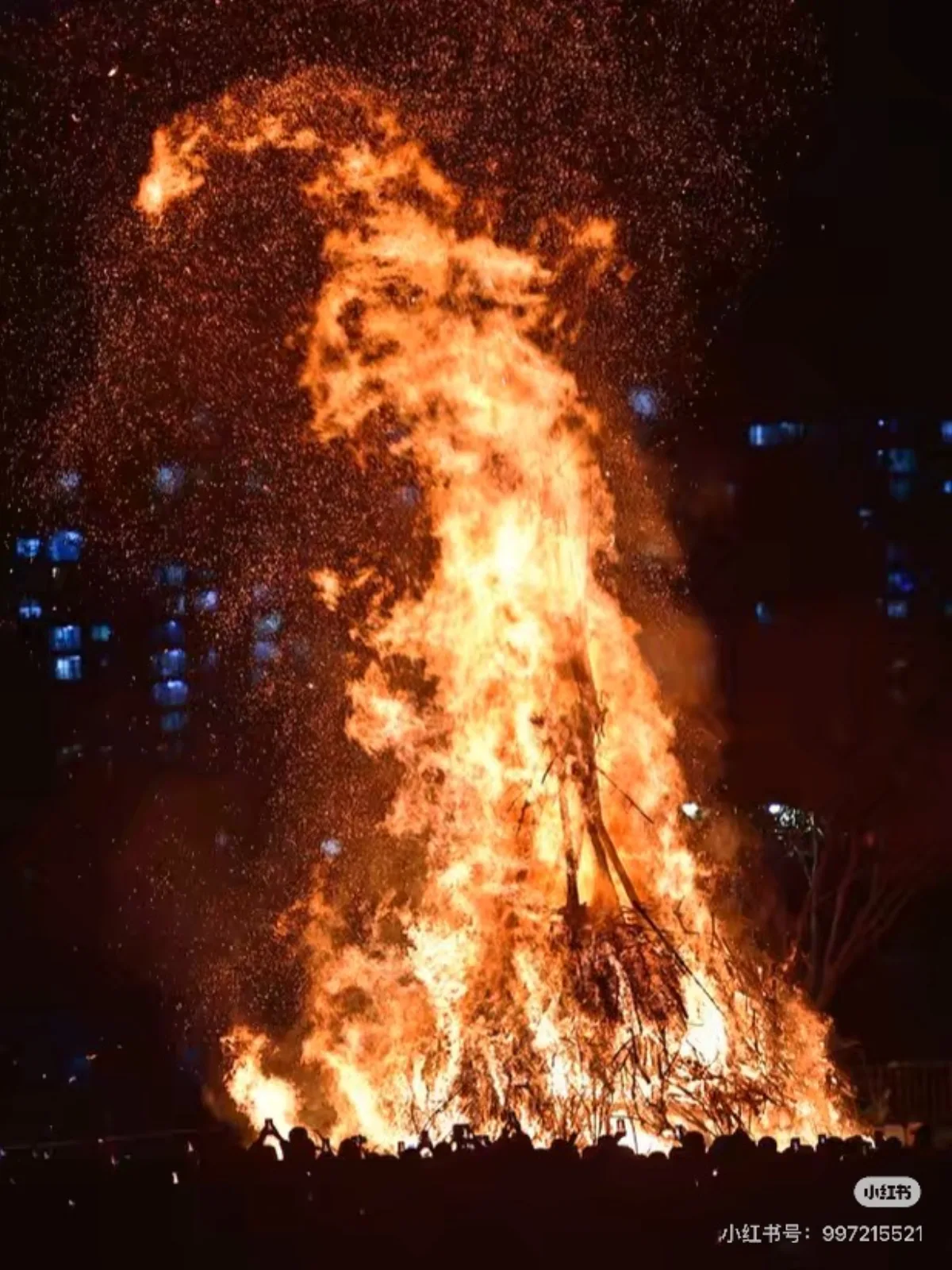
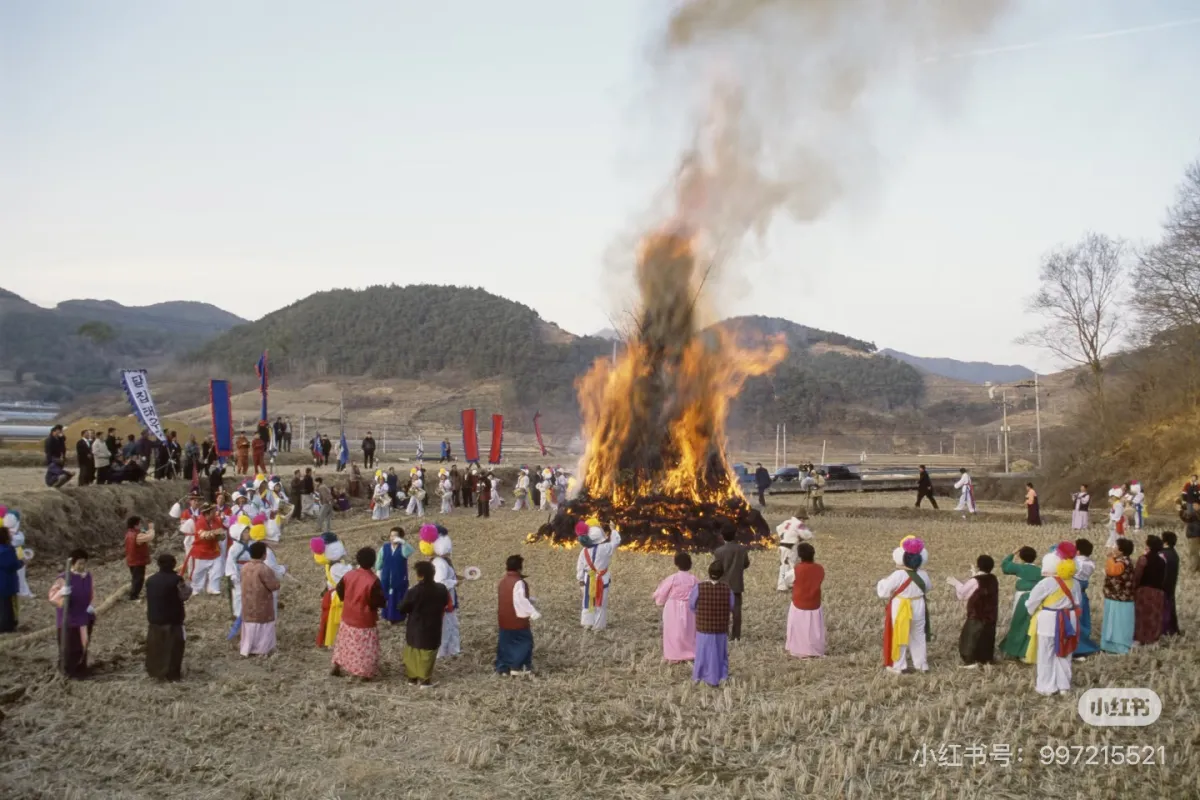
The most visually striking Daeboreum custom is Daljip Taeugui (달집태우기, "moon house burning"): villagers construct a large conical structure from rice straw, bamboo, and pine boughs, then set it ablaze when the full moon rises. Participants write wishes on paper and attach them to the structure to be burned. Folk belief holds that a vigorous, clean-burning fire ensures a good harvest and drives away evil spirits.
A "Tradition" Invented in Living Memory
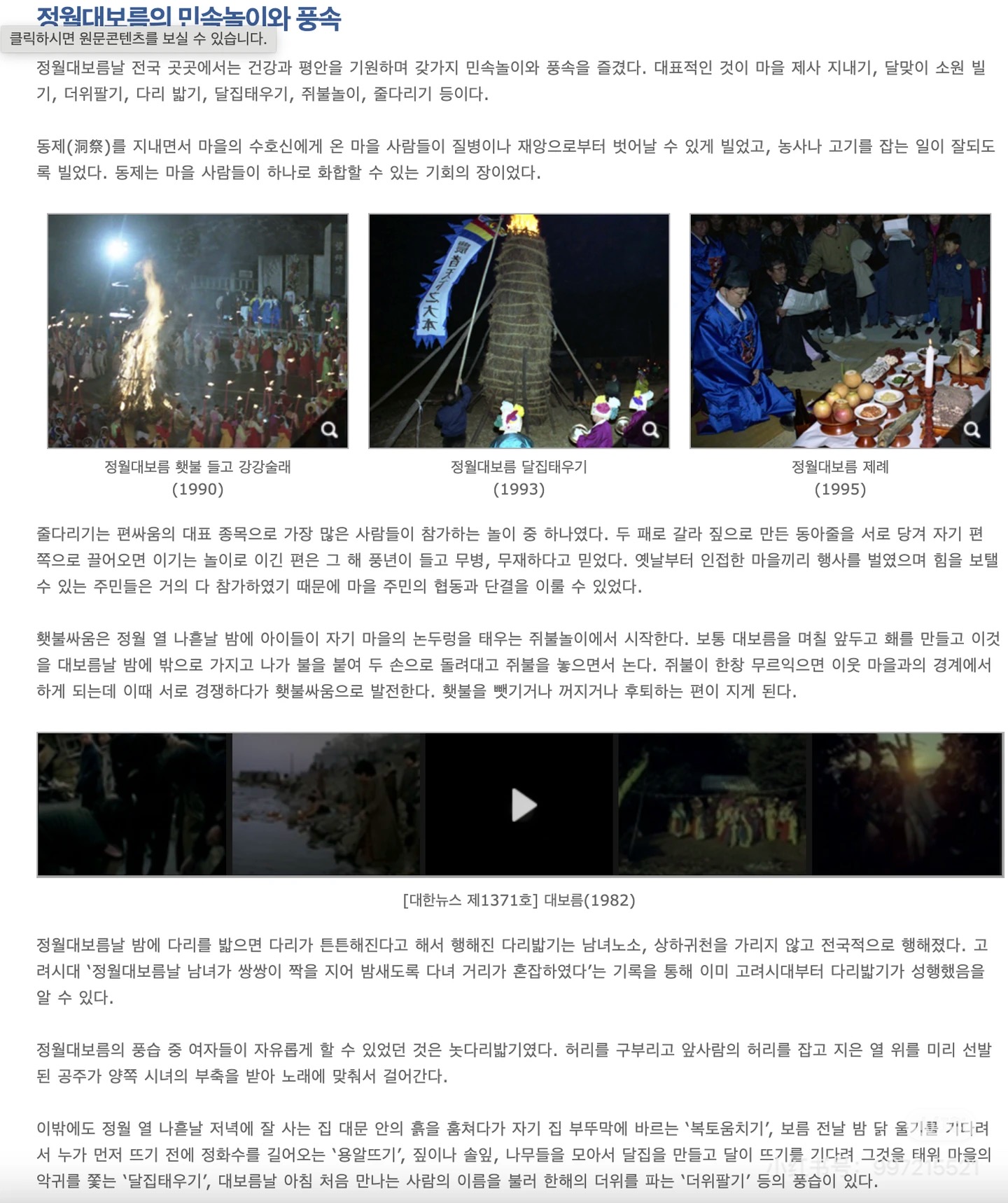
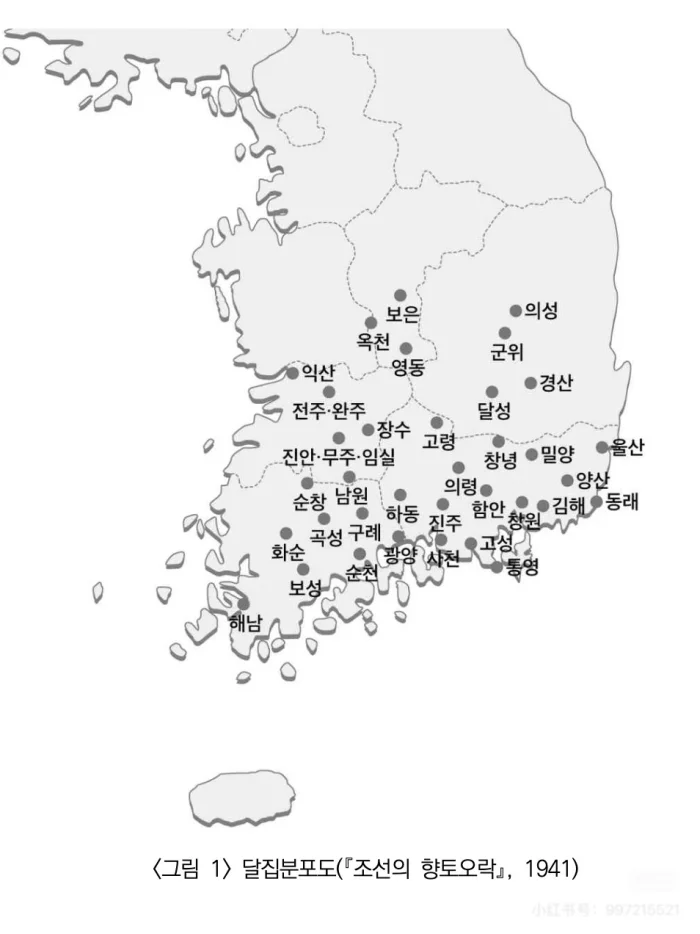
Despite being promoted as an ancient Korean tradition, daljip taeugui is absent from all major Joseon-dynasty seasonal customs texts — including the Dongguk Sesigi (東國歲時記, 1849), the Yeolyang Sesigi (洌陽歲時記), and the Gyeongdo Japji (京都雜志). These works exhaustively catalogue Daeboreum customs but never mention "moon house burning." The earliest systematic documentation comes from the 1941 Japanese colonial-era ethnographic survey Joseon-ui Hyangto Orak (朝鮮の鄕土娛樂, compiled by Murayama Chijun), which recorded it as a regional practice concentrated in southern Korea — not a nationwide custom.
Korean academic studies (Jeong Yeonhak, 2019; Seo Haesuk, 2016) acknowledge the absence of pre-modern textual evidence and note that the practice's expansion into a nationally promoted festival is a late 20th-century phenomenon, driven by local government sponsorship since the 1980s. Even residents of Seoul have noted that these bonfires appeared in their area only in very recent years — a pattern consistent with top-down cultural promotion rather than organic folk tradition.
Parallel Fire Customs Worldwide
Similar seasonal bonfire customs exist throughout East Asia and beyond. The Asian examples are all connected to the Lantern Festival date (15th of the first lunar month):
- Japan — Sagicho / Dondo-yaki (左義長 / どんど焼き): Documented in the 13th-century text Tsurezuregusa — at least 700 years of textual history, far predating any Korean documentation. Villagers burn New Year decorations (kadomatsu, shimenawa, daruma dolls) to send back the grain deity Toshigami. Concentrated in coastal areas, whereas Korean daljip occurs more in mountainous inland regions.
- China, Shanxi — Wanghuo (旺火, "prosperous fire"): In coal-rich Shanxi province, families build coal towers inscribed with "soaring prosperity" and ignite them at midnight on New Year's Eve. During the Lantern Festival, Huairen County erects large wanghuo reaching 10 metres high. Participants circle the fire three times clockwise and counterclockwise for good fortune.
- China, Fujian — Lantern Festival bonfires: In some Fujian communities, people jump through bonfires during the Lantern Festival for purification.
- Russia — Maslenitsa (Масленица): During this week-long festival marking the end of winter (late February to early March), Russians build and burn a large straw effigy of Lady Maslenitsa (Чучело Масленицы). The burning symbolises bidding farewell to winter and welcoming spring — the same seasonal-transition logic as East Asian fire customs. Maslenitsa has pre-Christian Slavic roots and is documented in Russian sources from the 16th century onward.
- United States — Burning Man: While not a traditional folk custom, the annual Burning Man festival in Nevada's Black Rock Desert (founded 1986) centres on the ritual burning of a large wooden effigy. Its creators drew consciously from global fire-ritual traditions. The event illustrates how modern societies create new communal fire ceremonies — a useful comparison point for understanding how daljip taeugui expanded from a minor regional folk practice into a major government-promoted national event within a single generation.
The shared calendrical timing across Asia (15th of the first month), agricultural prosperity symbolism, and communal fire ritual pattern all point to a common Chinese cultural root from which the East Asian variations developed. The European and American parallels demonstrate that communal bonfires at seasonal transitions are a deeply human impulse — but the specific calendrical framework in East Asia is Chinese.
Japanese Shōgatsu (正月)
Shōgatsu (正月) was historically celebrated on the lunisolar New Year — the same date as Chinese New Year. Japan subsequently imported updated Chinese calendars multiple times (697, 764, 862), using the Chinese Senmei-reki for nearly 800 years before producing its own calculated calendar in 1685.
The 1873 Calendar Switch
November 9, 1872 — The Decree
The Meiji government proclaimed that Meiji 5, 12th month, 3rd day (in the lunisolar calendar) would be followed by Meiji 6, January 1 — i.e., January 1, 1873 in the Gregorian calendar. The government effectively skipped nearly an entire month. The motivation was partly Westernisation (the bunmei kaika "civilisation and enlightenment" movement) and partly fiscal: Meiji 6 would have been a leap year with 13 lunisolar months, requiring the government to pay officials for 13 months. By switching, they saved one month's salary.
Japan has not officially celebrated the lunisolar new year since 1873. In the early Meiji years, rural communities resisted, but by the early 20th century the Gregorian New Year was fully dominant. Japan is the only major Asian civilisation to permanently sever its New Year from the lunisolar calendar.
Chinese-Origin Customs That Survive in Shōgatsu
Despite moving to January 1, Shōgatsu retains numerous customs with Chinese roots — thoroughly Japanified over centuries:
Lunisolar New Year in Modern Japan
Mainstream Japanese do not celebrate the lunisolar new year. However:
- Yokohama Chinatown (established mid-19th century) holds a major Spring Festival (Shunsetsu/春節) celebration annually.
- Kobe Nankinmachi (Kobe's Chinatown) similarly celebrates.
- Nagasaki Lantern Festival — Originally the Chinese New Year celebration of Nagasaki's Chinese community, it was expanded into a city-wide tourism festival in 1994 and now attracts approximately 1 million visitors over ~15 days.
- With nearly 800,000 Chinese residents in Japan (the largest foreign nationality), awareness of Chinese New Year has grown, but it remains perceived as a foreign festival.
Tibetan Losar (ལོ་གསར)
Losar (ལོ་གསར, "new year") is Tibet's most important holiday. The Tibetan calendar is a hybrid: the twelve-animal zodiac and five-element system were transmitted from China (especially after Princess Wencheng's marriage to Songtsen Gampo in 641 CE), while the astronomical calculation method is based on the Indian Kālacakra system introduced in the 11th century. Losar usually falls near Chinese New Year but can differ by a day, a week, or even a month due to different intercalary month calculations.
Distinctive Traditions
- Gutor (དགུ་གཏོར) — On the 29th of the twelfth Tibetan month, families perform elaborate cleansing rituals. A dough ball containing symbolic objects is thrown at a crossroads to cast away the old year's negativity.
- Lama Losar — The day before New Year is devoted to spiritual practice, with special prayers and offerings at monasteries. Monks perform cham dances (sacred masked dances) to dispel obstacles.
- Guthuk — A special nine-ingredient soup with hidden dough balls containing symbolic items that humorously reveal the finder's character.
- Chemar (ཕྱེ་མར) — A two-compartmented wooden box filled with tsampa (roasted barley flour) and dried wheat, decorated with coloured butter sculptures. Family members pinch tsampa and toss it in the air three times as an offering.
- Prayer flag renewal — Old prayer flags on rooftops are replaced with new ones at dawn on Losar, symbolising fresh spiritual energy carried by the wind.
The Tibetan Zodiac
Tibet uses the same twelve animals as China, combined with the five elements to create a sixty-year cycle. However, each element spans two years (male and female), giving a different rhythm. Tibetan year names combine element, gender, and animal: 2026 is a Fire-Male-Horse year (མེ་ཕོ་རྟ).
De-Sinicization: Erasing Chinese Origins
The 19th and 20th centuries saw deliberate campaigns across East Asia to sever connections with Chinese cultural influence — part of broader modernisation, nationalism, and colonial-era identity politics. These de-Sinicization (去漢化 / 脱中華) movements affected the lunisolar calendar, Chinese characters, and the New Year celebration itself.
Japan: The Meiji Break (1873)
Japan's adoption of the Gregorian calendar on January 1, 1873 was the most radical break. As part of the bunmei kaika (civilisation and enlightenment) movement, the Meiji government dismantled the Chinese-derived lunisolar system entirely. The lunisolar new year was not suppressed — it was simply erased from the calendar. Within a generation, no Japanese person celebrated it. Japan retained Chinese characters (kanji) in its writing system but permanently severed New Year from its Chinese calendrical roots.
Korea: Suppression, Reinstatement, and Rebranding
Korea's relationship with Chinese cultural heritage is the most contested. The lunar new year was suppressed during Japanese colonial rule (1910–1945), then continued to be discouraged by South Korea's own authoritarian governments until 1985/1989. Simultaneously, Chinese characters were progressively eliminated: the Hangul Exclusive Use Act (1948) and Park Chung-hee's 1970 decree removing Hanja from elementary education created a generation that no longer reads Chinese characters. The holiday was reinstated in 1989 but carefully branded as "Seollal" — a native Korean word — with no acknowledgment of its Chinese calendar origins.
Vietnam: Characters Gone, Tết Preserved
Vietnam abandoned Chinese characters through French colonial policy (1906–1919) and Ho Chi Minh's 1945 literacy campaign, which cemented the Latin-based chữ Quốc ngữ as the sole script. The last traditional Confucian civil service examination was held in 1919. Unlike Korea and Japan, however, Vietnam never abandoned or suppressed Tết. Even during the most intense anti-Chinese periods — including the 1979 Sino-Vietnamese War — Tết was continuously observed. The Communist government, despite ideological tensions with Beijing, recognised Tết as fundamentally embedded in Vietnamese identity.
Summary: What Was Abandoned
| Country | Chinese Characters | Chinese Calendar | Lunisolar New Year |
|---|---|---|---|
| Japan | Retained (kanji) | Abandoned 1873 | Abandoned 1873 — moved to Jan 1 |
| South Korea | Effectively abandoned (1948–1970s) | Retained | Suppressed 1910–1985; restored 1989 as "Seollal" |
| Vietnam | Abandoned (1906–1945) | Retained | Never abandoned — Tết continuously observed |
| Tibet | N/A (uses Tibetan script) | Hybrid (Chinese + Indian) | Never abandoned — Losar continuously observed |
The "Lunar New Year" Naming Controversy
In the 2000s–2010s, a campaign emerged — primarily from Korean and Vietnamese diaspora communities in the West — to replace "Chinese New Year" with "Lunar New Year" in English-language usage. The argument was that calling it "Chinese" New Year erased the celebrations of other Asian peoples. The counter-argument is that the holiday is Chinese in origin and the renaming is itself an erasure — of the Chinese source.
2012–2015
Western institutions (universities, corporations, city governments) began increasingly using "Lunar New Year" in official communications.
2015
New York City made Lunar New Year a public school holiday, using "Lunar New Year" rather than "Chinese New Year" — reflecting the diverse Asian-American community.
2022–2023
The controversy became especially heated on social media (TikTok, Twitter/X). Chinese users pushed back, arguing the holiday is Chinese in origin and renaming it is cultural erasure. Korean netizens argued Seollal is Korean, not Chinese.
February 2023
South Korea's Ministry of Culture, Sports and Tourism formally recommended that the English translation of Seollal be "Korean Lunar New Year" in official communications — explicitly distancing it from the Chinese origin.
December 2024
UNESCO inscribed the Spring Festival (春節) as Chinese intangible cultural heritage, escalating the naming debate further. Chinese online nationalists intensified standardisation campaigns; some Chinese companies were pressured for using "Lunar New Year" in marketing.
VANK: The Organisation Behind the Campaign
The most organised institutional force driving the CNY-to-LNY renaming is VANK (Voluntary Agency Network of Korea / 사이버 외교사절단, "Cyber Diplomatic Delegation"), a South Korean organisation founded in 1999 by Park Ki-tae (박기태). Originally a pen-pal network, VANK evolved into what it calls a "cyber diplomacy" organisation with ~120,000 Korean members and 30,000 international members — predominantly students.
VANK's campaign timeline:
- February 2019 — Formally launched campaigns targeting Google, foreign broadcasters, and governmental organisations worldwide to replace "Chinese New Year" with "Lunar New Year." VANK head Park Ki-tae stated: "Google's method of delivering information has others around the world believing that the Lunar New Year is a Chinese New Year."
- 2020–2021 — Petitioned the United Nations over stamps bearing "Chinese Lunar Calendar." Claimed success in getting Google to change its Knowledge Graph from "Chinese New Year" to "Lunar New Year."
- 2022 — Produced and distributed stickers globally promoting Korean Seollal as counter to what VANK called Chinese "cultural engineering" (文化工程).
- 2025 — South Korea's Korea Heritage Service (a government agency) formally partnered with VANK to promote Korean traditional holidays globally.
VANK's approach — described by academic Emma Campbell (ANU, 2011) as "bombarding organisations with emails and letters until they meet the demands" — has drawn criticism internationally. Foreign Policy characterised VANK members as either "self-styled cyber fact-checkers" or "hyper-nationalistic spammers." VANK has received indirect support through South Korean government-sponsored programmes, and its funding has been a partisan issue: progressive parties have advocated increasing it, while conservatives have sought cuts.
The campaign is not merely a translation preference. It represents a systematic effort to redefine the cultural narrative of the holiday — shifting its perceived origin from specifically Chinese to a generic "Asian" or "Lunar" celebration. This is why the counter-argument from Chinese communities frames the renaming not as inclusive language but as cultural erasure of the Chinese source.
The calendar is Chinese. The zodiac is Chinese. The customs are Chinese in origin. Calling it "Lunar New Year" to avoid saying "Chinese" does not change its history — it only obscures it.
The term "Lunar New Year" is also technically imprecise: the Chinese calendar is lunisolar (incorporating both lunar months and solar terms), not purely lunar. A truly lunar calendar — like the Islamic Hijri calendar — drifts through the seasons. The Chinese system does not, precisely because of its 24 Solar Terms.
Modern Cultural Tensions
Rather than a harmonious "revival" of shared heritage, the dominant trend is friction:
- Korea–China disputes over the origins of kimchi (vs. Chinese páocài), hanbok (vs. hanfu), Confucius's nationality, and the New Year naming have generated significant online animosity since ~2020.
- Vietnam–China tensions over South China Sea territorial disputes (particularly since the 2014 oil rig crisis) counterbalance any cultural rapprochement, despite growing Vietnamese consumption of Chinese dramas and social media.
- Japan has no comparable naming controversy — Shōgatsu is on January 1 and is unambiguously Japanese in its modern form.
Meanwhile, younger generations across East Asia consume Chinese pop culture at unprecedented rates — C-dramas, Douyin/TikTok, Chinese mobile games, chinamaxxing trends — while simultaneously asserting their national cultural distinctiveness. The pattern is: consume Chinese cultural products while denying or downplaying Chinese cultural origins.
For an in-depth look at the corporate rebranding of Chinese New Year — why the name matters, who is changing it, and what cultural erasure looks like in practice — see ChineseNewYear.wiki.
For a live tracker of how major organisations worldwide refer to the holiday — whether "Chinese New Year," "Lunar New Year," or "Spring Festival" — see CNYvsLNY.info.
Comparison Table
| Aspect | China | Vietnam | Korea | Japan | Tibet |
|---|---|---|---|---|---|
| Name | Chūnjié (春節) | Tết Nguyên Đán | Seollal (설날) | Shōgatsu (正月) | Losar (ལོ་གསར) |
| Calendar adopted | Origin (Shang, c. 1600 BCE) | 111 BCE (Han conquest) | 1st–4th c. CE (Three Kingdoms) | 604 CE (via Baekje) | 7th–11th c. CE (hybrid) |
| Calendar | Chinese lunisolar | Chinese-derived lunisolar | Chinese-derived lunisolar | Gregorian (Jan 1) since 1873 | Chinese-Indian hybrid |
| Chinese chars | In use (漢字) | Abandoned (1906–1945) | Effectively abandoned (1948–70s) | Retained (kanji) | N/A (Tibetan script) |
| Duration | 15 days | 7–9 days | 3 days | 3 days (Jan 1–3) | 15 days |
| Key Food | Dumplings, fish, niangao | Bánh chưng, mứt | Tteokguk (떡국) | Osechi-ryōri, mochi | Guthuk, khapse |
| Money Gifts | Red envelopes (紅包) | Lì xì (= 利是) | Sebaetdon (세뱃돈) | Otoshidama (お年玉) | Not traditional |
| Zodiac | 12 animals (Rabbit) | 12 animals (Cat) | 12 animals (Rabbit) | 12 animals (Boar) | 12 animals (Rabbit) |
| Decoration | Red couplets, lanterns | Mai/đào blossoms | Bokjumeoni pouches | Kadomatsu, shimenawa | Prayer flags, chemar |
| Holiday status | National holiday (7 days) | National holiday (7 days) | Suppressed 1910–1985; restored 1989 | Abandoned 1873 | Observed continuously |
Further Reading
For an in-depth look at the corporate rebranding of Chinese New Year — why the name matters, who is changing it, and what cultural erasure looks like in practice — visit ChineseNewYear.wiki.
Frequently Asked Questions
No. Chinese New Year (Spring Festival / Chūnjié) is the original celebration — documented since the Shang Dynasty (c. 1600 BCE) — from which other Asian New Year traditions derived. The term 'Lunar New Year' is a mistranslation (the Chinese calendar is lunisolar, not lunar) that was deliberately promoted to erase the word 'Chinese' from the festival's name. Korea has Seollal, Vietnam has Tết — each has its own name. There is no need for a fabricated 'collective term' that strips the festival of its documented Chinese origin.
Vietnam and Korea use calendar systems derived from the Chinese lunisolar calendar, so their New Year typically falls on the same day. Japan switched to the Gregorian calendar on January 1, 1873, permanently moving Shōgatsu to January 1st. Tibet uses the Kālacakra astronomical system, which occasionally differs from the Chinese calculation by a day, a week, or even a month.
During the Japanese colonial period (1910–1945), the lunar new year was suppressed in Korea. After independence, South Korea's authoritarian governments continued discouraging it, promoting January 1 instead. In 1985, the government partially restored it as 'Folk Day' (민속의 날). In 1989, it was fully reinstated as 'Seollal' (설날) with a 3-day national holiday.
On November 9, 1872, the Meiji government decreed that Japan would adopt the Gregorian (solar) calendar effective January 1, 1873. From that date, Japanese New Year (Shōgatsu) moved permanently to January 1st. Japan has not officially celebrated the lunisolar new year since 1873 — the only major Asian civilisation to completely sever this connection.
No. Unlike Japan and Korea, Vietnam never abandoned its lunisolar new year celebration. Tết was continuously observed even through wars and revolution. The 1968 Tet Offensive was shocking precisely because it violated a mutually agreed ceasefire during the sacred holiday. Vietnam's Communist government, despite ideological tensions with China, never attempted to abolish Tết.
South Korea enacted the Hangul Exclusive Use Act on October 9, 1948, mandating government documents in Hangul only. President Park Chung-hee removed Hanja from elementary textbooks in 1970. Vietnam abandoned Chinese characters (chữ Hán) and the native chữ Nôm script when the French colonial government mandated chữ Quốc ngữ (Latin script) from 1906–1919. Ho Chi Minh's 1945 literacy campaign cemented the change.
China, Vietnam, Korea, Japan, and Tibet all use variations of the twelve-animal zodiac cycle — all derived from the Chinese original. Vietnam substitutes the Cat for the Rabbit. Japan uses the same twelve animals (jūnishi) with Japanese readings, though since 1873 the zodiac year transition no longer aligns with the lunisolar boundary.
The Chinese Spring Festival has the oldest documented history, with roots in Shang Dynasty (c. 1600–1046 BCE) winter sacrificial rites. Vietnam's Tết dates to the period of Chinese rule beginning 111 BCE. Korea's Seollal developed through cultural exchange during the Three Kingdoms period (57 BCE–668 CE). Japan adopted the Chinese calendar in 604 CE.
VANK (Voluntary Agency Network of Korea) is a South Korean organisation founded in 1999 that has been the primary institutional force behind campaigns to replace 'Chinese New Year' with 'Lunar New Year' in English-language media. Since 2019, VANK has petitioned Google, the UN, and foreign media organisations. In 2025, the Korea Heritage Service partnered with VANK for global holiday promotion.
The Purple Mountain Observatory (紫金山天文台) in Nanjing is the sole official authority for computing the Chinese lunisolar calendar, a role formalised by national standard GB/T 33661-2017. Founded in 1934, it makes the Chinese calendar the only major traditional calendar system scientifically computed by a national institution.
Daljip Taeugui (달집태우기, 'moon house burning') is a Korean folk custom performed on Jeongwol Daeboreum (the 15th day of the first lunar month). Despite being promoted as ancient, it appears in none of the major Joseon-dynasty seasonal customs texts. The earliest systematic documentation is from a 1941 Japanese colonial-era survey, which recorded it as a regional practice concentrated in southern Korea. Korean academic studies acknowledge its nationwide expansion is a late 20th-century phenomenon.
Discussion
Sign in with GitHub to join the conversation.